Shaun Norris arrived at the Nexo Championship expecting to fight for position on the leaderboard, but instead found himself at the center of a controversy that quickly dominated discussion around the DP World Tour. A disputed two-stroke penalty changed everything and triggered an extraordinary confrontation.
The controversy began when officials ruled that Norris had allegedly improved the conditions affecting his stroke by altering his stance before playing the ball. Under the Rules of Golf, such an action can result in a penalty, but Norris immediately insisted that the interpretation was wrong.
Television cameras captured the incident from multiple angles, and Norris believed the footage supported his version of events. After receiving the penalty, he reportedly reviewed slow-motion video and became increasingly convinced that his movement had been completely within the rules governing play.
During his post-round press conference, Norris did not attempt to hide his anger. “This is completely unfair, and today I am the victim,” he declared, arguing that the decision had punished him for something he never intentionally did and something he believed the footage clearly disproved.
The South African golfer then pointed directly to the slow-motion replay, insisting that his feet had not deliberately manipulated the ground to create a more favorable position. According to Norris, his natural movement during the shot was being incorrectly interpreted as an attempt to improve his stance.
That distinction became the heart of the controversy. Norris argued that golfers frequently make minor adjustments while addressing the ball, particularly on uneven surfaces, and claimed that officials had crossed a dangerous line by treating an ordinary movement as a punishable violation under the rules.
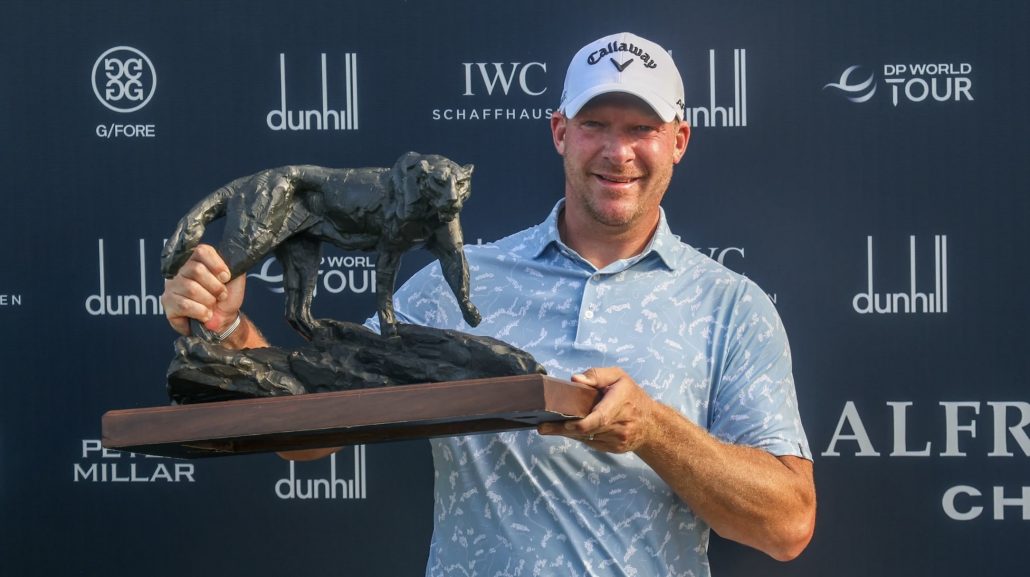
However, tournament referee Simon Higginbottom remained unmoved by Norris’s emotional defense. After reviewing the incident and the available evidence, Higginbottom maintained that the penalty had been applied correctly and that the ruling was based on the established interpretation of the relevant Rules of Golf.
His calm response only appeared to intensify Norris’s frustration. While the golfer continued to challenge the decision publicly, the official made clear that disagreement with a ruling did not automatically make the ruling incorrect. The clash immediately created two opposing camps among golf fans.
Supporters of Norris argued that slow-motion footage should have raised serious doubts about whether a penalty was justified. Critics, however, pointed out that video evidence can be deceptive, particularly when viewed repeatedly at reduced speed, making movements appear more deliberate than they actually seem in real time.
The two-stroke penalty carried significant consequences beyond the argument itself. In professional golf, a difference of two shots can dramatically alter a player’s position, affect momentum during a tournament, and potentially influence prize money, ranking points, and qualification opportunities depending on the event's final standings.

Norris therefore insisted that the issue was not simply about accepting an unfortunate decision and moving forward. From his perspective, the ruling directly affected the competitive outcome of his tournament. He argued that every shot should be judged consistently and that uncertainty must favor fairness.
As the dispute spread across social media, viewers began dissecting the footage frame by frame. Some believed the video showed Norris making only a natural adjustment before striking the ball. Others argued that the footage supported the officials’ conclusion that his movement improved his conditions.
The debate soon extended beyond Norris himself and became a wider argument about how modern golf should use technology. High-definition cameras, multiple broadcast angles, and slow-motion replay have created new opportunities for officials, but they have also produced complicated questions about interpretation and consistency.
Then came the development that stunned much of the golfing world. The R&A, golf’s governing authority responsible for overseeing the Rules of Golf alongside the USGA, became involved in the discussion surrounding the interpretation and the circumstances behind the controversial penalty decision.
Although Norris had already made his feelings unmistakably clear, attention suddenly shifted toward whether the governing body’s response would validate the referee’s position or raise further questions about the application of the rule. The possibility of clarification immediately intensified worldwide interest in the case.
For Norris, the damage had already been done. The two shots were added to his score, forcing him to continue the championship under the shadow of a decision he openly believed was unjust. Every subsequent shot became part of a tournament shaped by controversy.
The incident also highlighted the difficult position faced by tournament officials. Rules must be enforced consistently, yet golf regularly presents unusual circumstances in which intention, movement, ground conditions, camera angles, and interpretation can all become crucial factors in determining whether a violation actually occurred.
Norris nevertheless refused to soften his position. His message was clear: he believed he had been unfairly treated, he believed the footage supported him, and he believed the decision had made him an example rather than a player receiving an objective interpretation of the rules.
As the Nexo Championship continued, the focus remained split between the leaderboard and the growing fallout from Norris’s penalty. Whether the controversy ultimately changes any interpretation remains to be seen, but one thing was already certain: this was no ordinary two-stroke setback.
What began as a single ruling had become one of the tournament’s defining stories. Norris’s furious reaction, Higginbottom’s refusal to reverse course, and the subsequent attention surrounding the R&A transformed a brief on-course incident into a major debate about fairness, technology, and golf’s rules.
Now, the biggest question is whether Shaun Norris will eventually receive the vindication he has demanded—or whether the controversial two-stroke penalty will stand as a painful reminder that, in professional golf, one disputed movement can change far more than a scorecard.


:max_bytes(150000):strip_icc():focal(994x0:996x2)/dolly-parton-portraits-PEOPLE-4-87f98cdf39964f4dbd06efcdd933369a.jpg)